Setting up Connectivity using a FQDN
Learn how to configure TLS connectivity using a fully qualified domain name (FQDN).
To set up TLS connectivity using FQDN, you must create an OCI API Gateway instance and deploy it with the FQDN details.
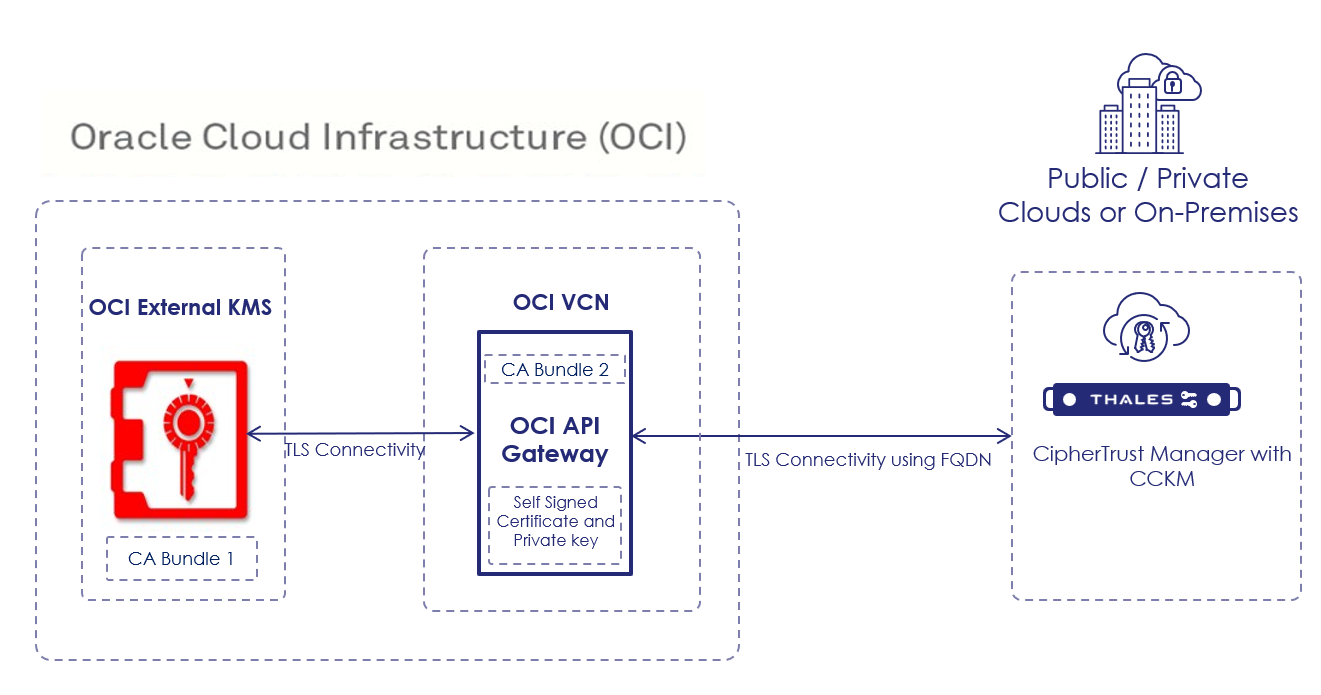
Overview: Two separate TLS trust chains (two CA bundles)
EKMS connectivity involves two different TLS connections, and each party must be able to validate the other party's server certificate:
-
OCI KMS (External KMS private endpoint) to OCI API Gateway (ingress)
Purpose: OCI KMS connects to the API Gateway over TLS.
Requirement: OCI KMS must trust the certificate presented by API Gateway.
-
OCI API Gateway (egress) to third-party KMS (external key manager)
Purpose: API Gateway forwards requests to the external KMS over TLS.
Requirement: API Gateway must trust the certificate presented by the third-party external key manager.
CA bundle best practices
For CA bundle uploads to OCI, the recommended default is to upload or install only the root CA certificate or certificates. This is the most stable approach and typically survives intermediate CA rotations without changes.
The server, such as API Gateway by default or a customer on-premises endpoint, must be configured to present the full chain during TLS. The full chain includes the server or leaf certificate and all required intermediate CA certificates.
Include intermediate CA certificates in the CA bundle only for one of these explicit reasons:
- Reliability: You have a requirement for resilience against on-premises servers that sometimes omit the intermediate certificate.
- Constrained trust: You have a requirement to accept only certificates issued under specific intermediate CAs.
Never include private keys in a CA bundle.